
Interaction nodes: human-in-the-loop and printer
Interaction nodes are where a pipeline talks to a person, either to ask for a decision or to hand back a formatted result.
Human-in-the-loop (HITL)
Section titled “Human-in-the-loop (HITL)”A HITL node pauses the pipeline and waits for a person to respond with one of three actions, each routable to a different next node:
| Action | Typical use |
|---|---|
| Approve | Continue down the main path |
| Edit | Send a modified value back into the pipeline before continuing — this needs a state key configured to receive the edit |
| Reject | Stop or divert to a different path |
Connect each action to whichever node should run next; an action with no route configured has nowhere to go. A HITL node is how you build an explicit approval step into a pipeline’s own logic — distinct from the guardrail confirmation prompt that can appear in chat before a sensitive tool call, which is triggered by admin configuration rather than a node you place yourself. See Require confirmation for sensitive actions for that related flow.
HITL nodes in nested agents and pipelines
Section titled “HITL nodes in nested agents and pipelines”A HITL node can pause a pipeline that an agent or another pipeline calls. For example, an agent calls a pipeline as a tool, and that pipeline runs a saved pipeline that has the HITL node.
- Each pause shows one approval card. The card shows the path of agents and pipelines above the HITL node.
- Each level keeps its own checkpoint. The run can continue after a worker restarts.
- When you approve or reject, the paused pipeline continues one time, at the level that paused. Then each caller continues.
- When you reject, the pipeline takes its Reject route. The tool after the HITL node does not run, and the caller reads the result of the Reject route.
Supported depth. A HITL node can have a maximum of 3 delegations above it. One delegation is an agent that calls another agent or a pipeline, or a pipeline node that runs a saved agent or pipeline. For example, an agent that calls an agent that calls an agent that calls the pipeline is supported. The delegation depth limit in Configuration › Delegation (default 4) also applies.
Not supported. The worker does not offer these pipelines to the agent. The agent answers without the pipeline, and the log names the pipeline and a reason code (pipeline.child_pause_unsupported):
| Reason | The pipeline can pause for |
|---|---|
pause_past_owner_path_tiers | A HITL node with more than 3 delegations above it |
hitl_gate_under_graph_root | A HITL node, in a pipeline that an agent node of another pipeline calls as a tool |
sensitive_tool_approval | A sensitive tool confirmation, in a pipeline that an agent calls as a tool |
clarifying_questions | A clarifying question, in a pipeline that an agent calls as a tool |
mcp_authorization | An MCP sign-in, in a pipeline that an agent calls as a tool |
unscoped_agent_node | A pause in an agent node that the worker cannot resume at that position |
static_pause_under_graph_root | A static tool pause, in a pipeline that an agent node of another pipeline calls as a tool. The worker refuses the whole run, not only the pipeline |
Printer
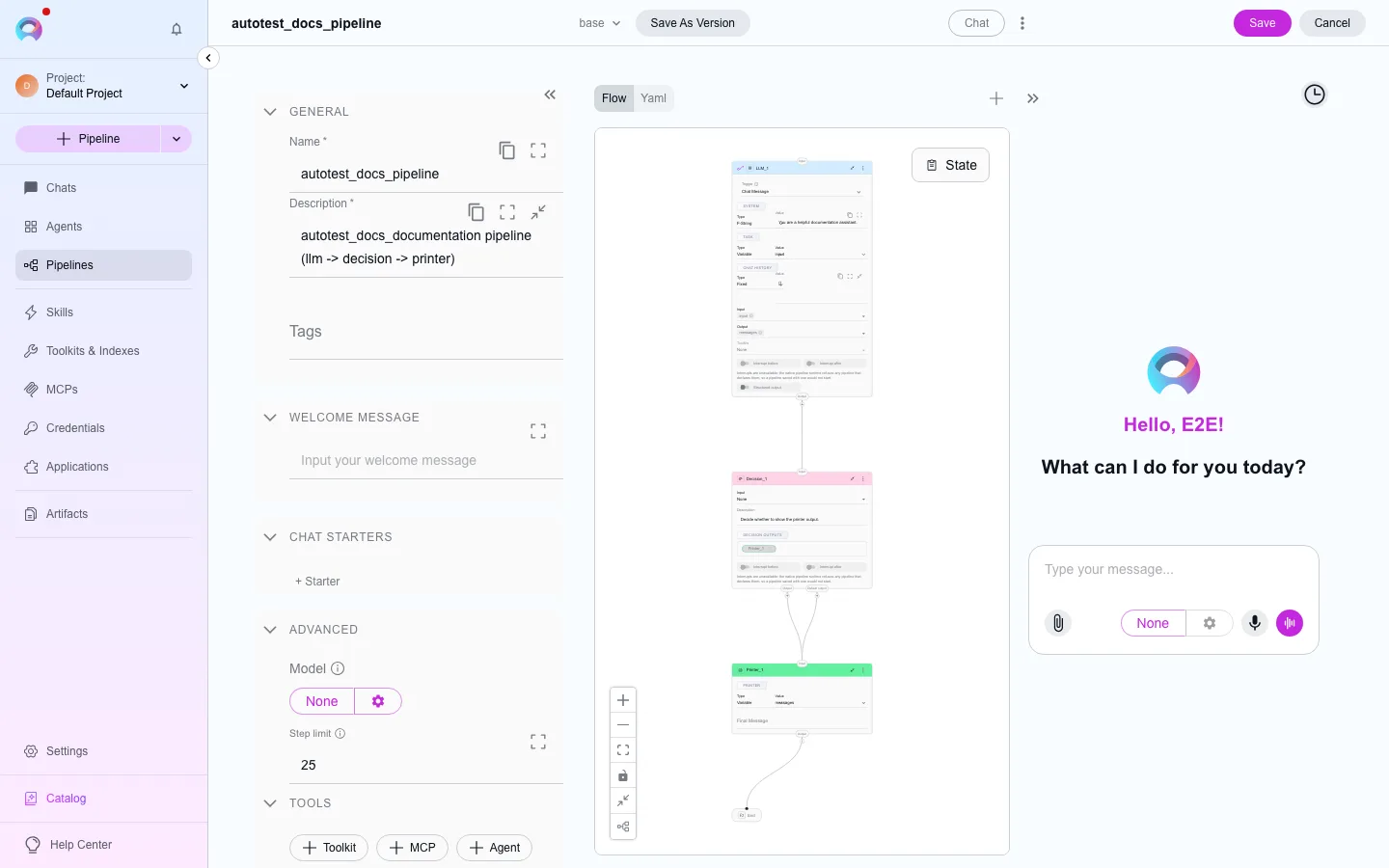
Section titled “Printer”A Printer node formats a final message and writes it to the pipeline’s output — typically the last node before END in a path that should show something back to the user. It takes the content you want printed (which can reference earlier state) and stores it in the reserved printer_output state key.
Because printer_output is a reserved state key, don’t reuse it for anything else in the same pipeline — a later node that overwrites it silently replaces whatever the Printer node produced. See Pipeline structure for the full list of reserved keys.