

Control-flow nodes: decision, router and state
Control-flow nodes decide what happens next, or reshape the pipeline’s state without calling an external service.
Router
Section titled “Router”Evaluates a template condition (Jinja-style) against the pipeline’s state and picks one of several named routes, with a default fallback if nothing matches.
| Field | What it does |
|---|---|
| Condition | A template that resolves to one of your route names — for example, branching on whether a state variable contains “approved” |
| Routes | The node IDs the condition can resolve to; route names must exactly match a node ID, case-sensitively |
| Default output | Where to go if the condition resolves to nothing recognized |
Router is fast and deterministic — no model call — best when the branching logic is an explicit rule.
Decision
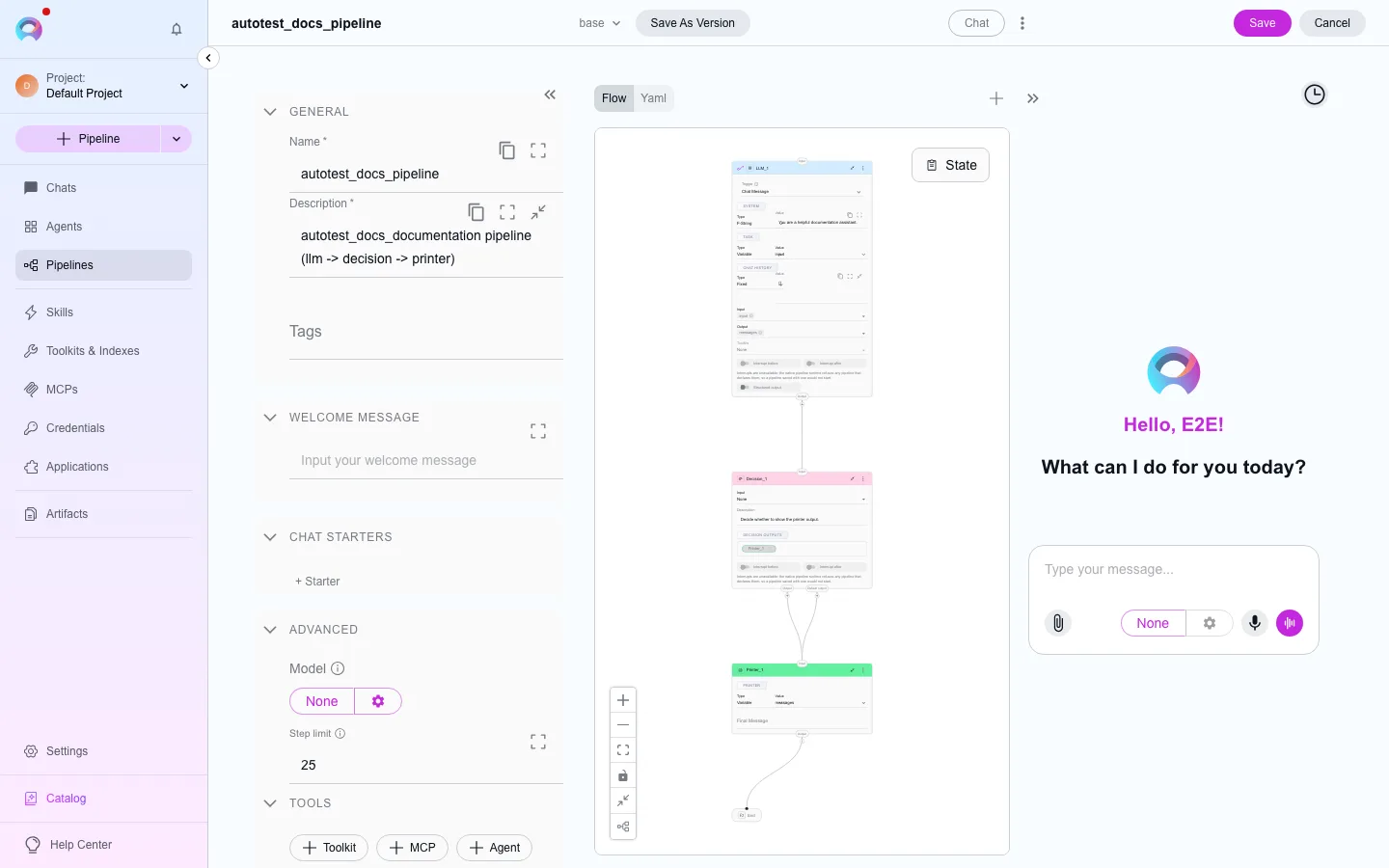
Section titled “Decision”Uses an LLM to pick a route based on a natural-language description, instead of a template rule. Best for routing that depends on interpreting meaning rather than matching a fixed pattern.
| Field | What it does |
|---|---|
| Description | Plain-language instructions telling the model how to choose between routes |
| Decision outputs | The node IDs the model can choose from |
| Default output | Fallback route if the model can’t decide confidently |
Decision nodes are slower than Router (they make a model call) and cannot connect directly to another Decision node — put a Router, LLM, or Toolkit node between two decisions if you need a second one in sequence.
State modifier
Section titled “State modifier”Reshapes the pipeline’s state without calling a model or a tool: combine values, format text, do simple arithmetic, or clear out variables you no longer need.
| Field | What it does |
|---|---|
| Template | A Jinja-style template referencing input variables — for example, Hello, {{ user_name }}! |
| Input | The state variables the template is allowed to read |
| Output | Where the rendered result is written |
| Variables to clean | Optional list of variables to reset afterward (strings to "", lists to [], numbers to 0) |